

#The critic and the crackdown
A YouTuber asked where one customer’s collection went; the company answered with a racketeering suit, a gag order, and, after a traffic stop, a search warrant that seized nothing.
The collection at the center of all of it was a stack of retired LEGO sets, Star Wars boxes, loose minifigures, that a man named Mansell had handed to a Bricks & Minifigs store on consignment. The paperwork was plain about who owned them. The consignment agreement, signed November 22, 2023, said in so many words that the merchandise “shall remain the property of Mansell until sold.” When the goods went missing in the churn of a store changing hands, that single sentence became the seed of a public fight.
The man who watered it was Benjamin Schneider, a YouTuber who posts as “Reckless Ben.” He started asking, on camera, where the collection had gone, and then asking louder. The videos found an audience and kept climbing; by the time lawyers got involved the company’s own court filing would describe the “Publications” as having drawn on the order of 1.3 million views. BAM v. Schneider-Mansell, No. 260402353 What had begun as one consignor’s grievance was now a consumer-advocacy campaign with a running headcount in the seven figures.
BAM Franchising’s response was not a refund. It was a lawsuit, and not an ordinary one.
#Thirteen counts
On May 27, 2026, BAM filed a verified complaint in Utah’s Fourth District Court, case No. 260402353, built around the Utah Pattern of Unlawful Activity Act, the state’s racketeering statute. The named defendants were Schneider himself, his company Reckless Ben LLC, the consignor Mansell, and a fourth man, Victor Nguyen, along with unnamed Does the complaint lumped together as the “Schneider Group.” Verified Compl., BAM v. Schneider-Mansell, No. 260402353 The pleading ran to thirteen counts and leaned on seven enumerated racketeering predicates, communications fraud, theft by deception, theft by extortion, criminal simulation, deceptive business practices, forgery, and obstruction. Verified Compl., BAM v. Schneider-Mansell, No. 260402353
To turn a critic into a racketeer, a complaint needs more than criticism, and BAM’s reached for it. The filing alleged a $200,000 extortionate demand tied to a threat that things would get “very bad,” a separate $300,000 demand built around “damaging videos,” and a $40,000 demand resting on a forged contract. Verified Compl., BAM v. Schneider-Mansell, No. 260402353 It described props from the campaign as crimes: a counterfeit Guinness World Record certificate, fake raffle tickets, allegedly forged court papers. Verified Compl., BAM v. Schneider-Mansell, No. 260402353 Those are the kinds of acts, fabricated documents, dollar demands, that have nothing to do with reputation and everything to do with the elements of a felony, which is precisely why they anchor the complaint.
What the complaint conspicuously did not contain was a finding that anything Schneider had said was false. On the contrary, by its own paragraph the pleading conceded that no court and no law-enforcement agency had ever found that BAM stole or wrongfully converted anyone’s property, and it characterized the underlying mess as a private, store-level dispute at an independently owned Salem franchise. Verified Compl., BAM v. Schneider-Mansell, No. 260402353 These are allegations, sworn but undecided; none has been adjudicated. There is daylight, too, in the complaint’s own attributions: the $300,000 “damaging videos” demand it pleads is laid not at Schneider’s feet but at those of two non-defendants. Verified Compl., BAM v. Schneider-Mansell, No. 260402353
There is a documentary wrinkle that sits awkwardly beside the racketeering theory. Days before the suit, on May 21, BAM had circulated a corrective note about the dispute, the company’s own public account, later filed as an exhibit to the very complaint that called Schneider a criminal for talking about the same facts. BAM v. Schneider-Mansell, No. 260402353 And in a separate Utah Business and Chancery Court case, No. 260200029, the franchisee side pressed its own claims against BAM over the seized store and the consigned collection. Compl., No. 260200029 That suit’s exhibits included LEGO’s own letter stating, flatly, that “Bricks & Minifigs isn’t affiliated with the LEGO Group in any way”, a fact that cut against the store’s pitch, and the termination paperwork at the heart of the franchise fight. Exhibit A Bricks-and-Minifigs-Case-260200029-Exhibit-A-LEGO-Email, No. 260200029 Exhibit D Bricks-and-Minifigs-Case-260200029-Exhibit-D-Termination-Letter, No. 260200029 By June 4, 2026, in its own press release, BAM announced it had closed the Salem store, agreed to ‘part ways’ with the insiders who had taken over its inventory, and said it was prepared to compensate Mansell for the collection.
#The order to take it down
Five days after filing, on June 2, 2026, BAM got what it most wanted: an order telling Schneider what he could say and ordering the videos gone. The Fourth District Court, through Judge Tony F. Graf, Jr., entered a temporary restraining order on BAM’s ex parte motion, that is, after hearing only one side. The order made no finding that any statement was false; it rested on a recital that BAM was “substantially likely to prevail.” BAM v. Schneider-Mansell, No. 260402353
Two of its clauses reached pure speech. Clause 5(j) barred Schneider going forward from “creating, posting, publishing and disseminating (or any republication thereof) any false, misleading, harassing, interfering, defamatory or unlawful images or content” about BAM. BAM v. Schneider-Mansell, No. 260402353 Clause 5(k) went further into the past tense, commanding that the already-published videos “be immediately removed and/or taken down from any online streaming platform.” BAM v. Schneider-Mansell, No. 260402353 No bond was required, and a hearing on a longer-lasting injunction was set for June 22. BAM v. Schneider-Mansell, No. 260402353
That same clause reached past the people BAM had actually sued. Clause 5(k) restrains publications relating to “the private legal dispute underlying this matter between Bryan and Chrystal” BAM v. Schneider-Mansell, No. 260402353 — naming, in the operative restraint, a non-party: Chrystal Law, who with her husband Benjamin Gorman ran the Salem store through BAMF Salem 1, LLC and is herself a plaintiff against BAM in the separate Utah Business and Chancery Court action, No. 260200029. Compl., No. 260200029 On June 16, 2026 the Law-Gorman side did exactly that. Through counsel Sarah Spencer, the former Salem franchisees moved to intervene on a limited basis and to modify or dissolve the June 2 order, and the motion is now in hand. Mot. to Dissolve TRO, No. 260402353 It makes the constitutional case directly: that Clause 5(k) is an unconstitutional prior restraint entered with no finding of falsity, that it is overbroad enough to sweep in true statements and reports of public court filings, and that an injunction cannot bind known non-parties who were never served, joined, or heard. Mot. to Dissolve TRO, No. 260402353 It reserves the franchisees’ rights under Utah’s anti-SLAPP statute, and it is pointedly careful to take no position on relief aimed at conduct the defendants are “alleged to have engaged in,” naming “true threats, doxxing, trespass, or impersonation.” Mot. to Dissolve TRO, No. 260402353 The objection is substantial: a speech-restraining order that binds people who were never named as defendants, about their own dispute, stands on especially thin constitutional ground.
An order forbidding speech before it is published, and compelling the deletion of speech already published, is the textbook definition of what the law calls a prior restraint, “the most serious and the least tolerable infringement on First Amendment rights,” in the Supreme Court’s phrase, carrying a heavy presumption against its validity. Near v. Minnesota ex rel. Olson, 283 U.S. 697, 713-20 (1931)✓ Nebraska Press Ass’n v. Stuart, 427 U.S. 539, 559 (1976)✓ Bantam Books, Inc. v. Sullivan, 372 U.S. 58, 70 (1963)✓ The closest case on the facts is one in which the Court struck down an injunction against leaflets criticizing a businessman’s practices, holding that fear of commercial harm does not justify silencing the critic. Org. for a Better Austin v. Keefe, 402 U.S. 415, 418-19 (1971)✓ Utah’s own Supreme Court has said the same and added a procedural point that fits this order like a glove: a speech restraint entered without notice and a hearing is invalid. KUTV, Inc. v. Conder, 668 P.2d 513, 517-25 (Utah 1983)✓ BAM’s strongest answer is that it was enjoining conduct, threats, impersonation, not commentary; that defense is sturdiest as to the clauses about harassment and weakest as to the two that reach a published video. None of this has been resolved; the question of whether the speech clauses survive is exactly what the June 22 hearing was set to decide.
The order was not the only pressure on Schneider’s ability to speak and to fund the fight. BAM’s campaign extended to the platforms that carried him. Patreon’s CEO, Jack Conte, said publicly that on May 29, 2026 Patreon received “an official takedown request filed by Bricks and Minifigs” over the Reckless Ben media and accounts, citing the verified complaint and the temporary restraining order, and that after an internal review Patreon refused the request and kept his page up. Patreon takedown-notification statement (Jack Conte) Where a content-based gag dictates what may be published and a takedown demand reaches the money behind it, the squeeze is felt before any judge ever rules on whether a word of it was untrue.
#A traffic stop, a warrant, and nothing seized
Then the dispute left the courthouse and turned into a criminal case.
After a traffic stop, the American Fork Police Department obtained Search Warrant No. 3352981. Its affiant, Officer Cole G. Richardson, swore he had been a “POST certified officer as of 2024” with “over a year” of experience; the warrant was signed by Fourth District Judge Roger W. Griffin. The charge was stalking, and the warrant carried an unusual rider: authorization to seize LEGO merchandise. American-Fork-Police-Warrant-3352981-Search-Warrant Statement American-Fork-Police-26AF02033-Probable-Cause-Statement The investigation was opened under the department’s own incident number and written up as a stalking-and-harassment matter. American-Fork-Police-26AF02033-Stalking-Harassment-Incident-Report When officers executed the warrant, the return tells its own story. The line for what was taken reads: no items seized. American-Fork-Police-Warrant-3352981-Search-Warrant A warrant that named LEGO as its quarry came back empty.
The department’s own records name the officers. The raid was led by Richardson, with Lieutenant Q. Adamson on the perimeter, Officer J. Laycock at the point of the entry team, Sergeant Lott, and Officers Spencer Tonga, D. Gonzalez, Jensen and A. Neil; the case detective, W. Nicosia, authored the probable-cause statement. American-Fork-Police-26AF02033-Stalking-Harassment-Incident-Report The affidavit invites one question on its face: its narrative dates the triggering incident to “March 3rd,” although the warrant was sworn and served on March 11 and the affidavit’s own surveillance note bears the later date, an inconsistency in a document submitted under oath. American-Fork-Police-Warrant-3352981-Search-Warrant A profile compiled for American Fork on the national giglio-bradylist.com Brady-list database flags a “Brady/Giglio concern” arising from the matter and asserts that the department “has refused or failed to fully identify its involved officers by complete legal name and headshot” — an aggregator’s characterization, offered here as such and not as an official disclosure.
Officers arrested Schneider anyway and booked him. American-Fork-Police-26AF02033-Booking-Sheet Prosecutors filed a criminal information; he was advised of his rights, and the court entered a pretrial protective order. Reckless-Ben-Utah-Case-261000376-Advisement-of-Rights, No. 261000376 Reckless-Ben-Utah-Case-261000376-Information-and-Indictment, No. 261000376 Order, No. 261000376 Docket Case History Reckless-Ben-Utah-Case-261000376-Docket-Events, No. 261000376 It bears stating as plainly as the presumption demands: the criminal charges against Benjamin Schneider are unadjudicated. He has been accused, not convicted. Nothing here decides whether he did anything wrong.
Honesty about those charges cuts the other way, too, and the credibility of everything else here depends on saying so. The American Fork case is not only stalking; its second count is targeted residential picketing, and a companion case in Provo charges criminal trespass and disorderly conduct, which has since moved through arraignment and a June 2026 continuance before Judge Stephen Schreiner, the proceedings preserved on the court’s own audio. Criminal - American Fork Probable Cause Affidavit - Stalking + Targeted Residential Picketing (261401094), No. 261401094 The arresting officer’s sworn affidavit describes conduct well past posting videos: after being formally trespassed from a BAM insider’s American Fork home, Schneider and others returned to it repeatedly, parked outside with cars of people, photographed the house with the family inside, sent others to knock at the door, and planted a sign in the park strip bearing the resident’s face and the words “I stole a dying man’s life savings”; one visitor posed as a delivery driver to get a signature. Criminal - American Fork Probable Cause Affidavit - Stalking + Targeted Residential Picketing (261401094), No. 261401094 on the record 18:49 · 3/9 Those acts are confrontational, and the State charges them as crimes. Schneider’s account is that they were attempts to serve civil process and to report a story the consignor’s family had asked him to pursue, against a man his videos accuse of helping strip a dying father’s collection on the record 16:17 · 3/11 — and the officer’s own report concedes the police understood the visitors “were trying to serve him civil papers.” Criminal - American Fork Probable Cause Affidavit - Stalking + Targeted Residential Picketing (261401094), No. 261401094 Both readings can hold at once: the conduct was aggressive enough to charge, and the complainant was a BAM insider who phoned the police day after day to turn a business grievance into a criminal file. on the record 12:56 · 3/8 Which one a jury would credit is exactly what has not happened yet.
There is a second, uglier thing the record makes plain. BAM’s filings collect a wave of messages the company and the McNeff family received once the videos went viral: anonymous notes threatening to mail “explosive” sets and to burn the stores and headquarters, a message promising a bullet with the chief executive’s name on it, wishes of cancer on the family, racist abuse, and online comments musing that “buckshot solves a lot of issues.” McNeff v. McNeff, No. 2:21-cv-00048 (D. Utah) Those threats are real and they are vile, and no account of who wronged whom should pretend that a family fielding bomb and death threats is a comfortable place to stand. But nearly every one of them is pseudonymous, sent from throwaway handles and burner accounts, and they read as the work of the furious audience a million-view accusation summons, not as anything traced to Schneider’s own hand. That gap is the whole of BAM’s racketeering theory, which bundles the mob into a “Schneider Group” and asks a court to hold the journalist answerable for what his viewers did. The law has long resisted that move: a speaker is not liable for the independent lawless acts of those who hear him, absent incitement. NAACP v. Claiborne Hardware Co., 458 U.S. 886, 927-29 (1982)✓ Whether BAM can bridge the gap is, again, undecided; that it has not is why the threats sit in an exhibit rather than in a verdict.
The criminal matter runs on two separate tracks: the Fourth District stalking case, State v. Schneider, No. 261401094 (stalking and targeted residential picketing) before Judge Thomas Low, with a hearing set for July 1, 2026; and a separate Provo City Justice Court case, No. 261000376 (disorderly conduct and criminal trespass) before Judge Stephen H. Schreiner, in which Schneider entered not-guilty pleas. Reckless-Ben-Utah-Case-261000376-Advisement-of-Rights, No. 261000376 Reckless-Ben-Utah-Case-261000376-Information-and-Indictment, No. 261000376
Three of the people detained at the Airbnb that day — Sheldon Norcross, Sierra Lauts and Tyler Shaw — have since launched a public fundraiser, “Justice for Sheldon and Friends,” to pursue civil-rights litigation against the department; of the five taken into custody, only Schneider was booked into jail. The campaign states that counsel advised their “rights were likely violated” and that a civil-rights attorney is being retained. No suit has been filed, and the civil-rights claims are the organizers’ own, untested allegations.
What makes the arrest more than a footnote is what the body cameras recorded, and what the public was first allowed to see. The American Fork Police Department released its bodycam footage as a set of 56 clips, but only after editing it. According to the bodycam investigation built from the records, roughly three hours of video were blacked out, eleven clips were withheld entirely, and about ninety-four minutes of audio were muted. AFPD bodycam redaction audit (redacted release vs unredacted leak) The deletions were not scattered at random; they clustered on exactly the moments that mattered, the officers’ own on-scene legal assessment, the warrant’s execution, and the arrest itself.
So it does look like he has an active warrant, but unfortunately it isn't serviceable. Oh, really? The jail wouldn't take on that, on the charges that he has a warrant for. Got it. So what would they do? What good is the warrant? Usually, it's just if they make contact, it's advised to take care of
Watch this momentReleased American Fork PD body-camera footage (the public archive.org copy). The synced viewer reproduces the department’s own redaction as black boxes; X-Ray lifts them to show what was blacked out.
The reason anyone could measure the gap is that an unredacted copy of the same clips had leaked, and the leak was the department’s own mistake: a misconfigured Dropbox, not a hack. AFPD bodycam redaction audit (redacted release vs unredacted leak) Laid frame against frame, the official release and the leaked original made the muted minutes legible again. In the recovered audio, the investigation captures an officer saying, at the traffic stop, “I was going to scare him a little bit and let him go is all I really was going to do,” and another asking, “We have charges, or we just tired of them being annoying?” These are the documented findings of that bodycam comparison, drawn from leaked and public records and presented here as such, not as a court’s conclusion.
Search warrant? Yeah. That's crazy. Are we all going? No knock, search warrant. I've never seen that before. It wasn't no knock. Your door was open. Was it? Yeah. So you can just go in. Yeah. Well, we didn't go in. No. Called you to us, right? Oh yeah. Called you out. Announced and said, come out he
Watch this momentReleased American Fork PD body-camera footage (the public archive.org copy). The synced viewer reproduces the department’s own redaction as black boxes; X-Ray lifts them to show what was blacked out.
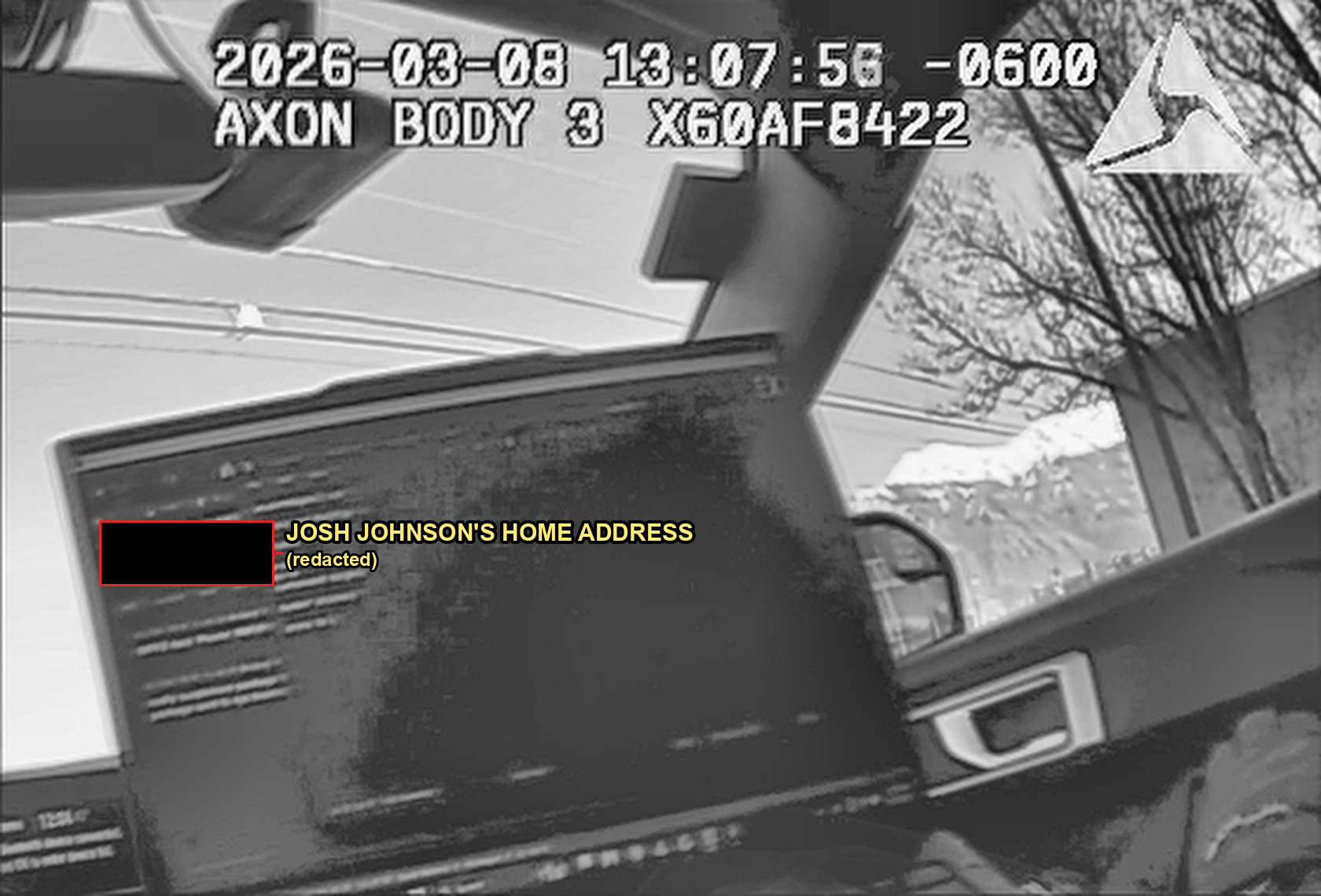
The recovered audio was not the only thing the black boxes had hidden. The same leak made one of the department’s in-car computer screens legible again, and it answers a question the official release did not: who set the matter in motion. The screen logs the reporting party as Johnson, the record opened at his own American Fork home address, with a narrative about a “suspicious package” and footage supplied by “my business partner.” AFPD bodycam redaction audit (redacted release vs unredacted leak) That is Josh Johnson, one of the two insiders BAM installed as the Salem store’s new owners; his “business partner” is Brandon Best, the inventory inspector who became the other. The man who helped take over the store is also, on this record, the one who summoned the police against its loudest critic and handed officers the video. on the record 14:41 · 3/8 A company that answers a critic with a racketeering suit, a gag order, and a police referral is not a harassment victim defending itself; it is reaching for every institution it can. The law has names for that, too. Using the criminal system as leverage in a private dispute is what courts call abuse of process, and unlike a malicious-prosecution claim — which cannot even be filed until the criminal case ends in the accused’s favor — an abuse-of-process claim can in theory be brought while the charges are still live, turning on a wrongful act beyond the filing itself — the disputed “no court cases” report being the natural candidate — though Utah courts have lately been skeptical that a retaliation-motivated report clears that bar, which makes it a contested route rather than a sure one. Eldridge v. Johndrow, 2015 UT 21, 345 P.3d 553✓ Mackey v. Krause, 2025 UT 37, 575 P.3d 1162✓ And when a private complainant and the police pull toward a shared end — here, on the recovered audio, an officer is heard asking whether they “have charges, or we just tired of them being annoying” — civil-rights law can treat the private party as if he were the state, so the complainant’s standing as the franchisor’s own man strengthens that link rather than breaking it. Dennis v. Sparks, 449 U.S. 24 (1980)✓ Those are the arrestees’ claims to pursue; the charges against Schneider remain unadjudicated, and he is presumed innocent.
The police paperwork says much of this on its face. The probable-cause affidavit for the arrest, sworn the day before the search warrant, records that the complaining “victim” “works for a company that recovered property from a franchise location in Oregon,” that “a third-party involved in the franchise was trying to hold him responsible for property at that location,” and that this third party “hired Benjamin, a YouTuber, to harass” him — the Salem repossession and the Mansell consignment, told from the franchisor’s side of the counter. on the record 12:55 · 3/8 The same officer wrote that he “explained to the victim that the individuals were trying to serve him civil papers,” and that the victim and “the victim’s boss” both “reiterated that there were no court cases involving the victim or the company” — a representation that sits uneasily beside the Law/Gorman action then pending in the Utah Business and Chancery Court. Compl., No. 260200029 The search warrant that issued the next day sought “any stolen merchandise, specifically Lego merchandise” yet was predicated on the crime of stalking, rested in part on an Airbnb homeowner who “provided video footage” and “disclosed that he could hear multiple individuals inside the residence,” and closed by stating its purpose: “in order to affect the arrest of Benjamin Schneider.” American-Fork-Police-Warrant-3352981-Search-Warrant These are the affidavits’ own words; the charges remain unadjudicated, and the homeowner’s role as a possible agent of the police is a separate question for counsel. And the affidavit and the record tell two different stories about that footage: the cooperative “homeowner” the warrant credits is, on the department’s own in-car-computer log, the same video supplied not by a neutral neighbor but by Johnson’s “business partner,” the insider Brandon Best.
The law has names for the questions the warrant raises, and the first arrives before stalking is even mentioned. A search warrant has to tie the specific thing being looked for to the crime being investigated; probable cause to suspect a person is not a license to hunt for objects that have nothing to do with the offense. Mink v. Knox, 613 F.3d 995 (10th Cir. 2010)✓ United States v. Mora, 989 F.3d 794 (10th Cir. 2021)✓ Stalking is a course-of-conduct crime about fear and harassment; it carries no element of theft, and a warrant that recites stalking while authorizing a hunt for “stolen Lego merchandise” yokes together a crime and an object that do not belong in the same sentence. The warrant’s own stated purpose makes that worse rather than better: a search warrant exists to find evidence in a place, not, in the affidavit’s words, to “affect the arrest” of a person, and a sworn document that says so out loud describes a tool aimed at something it was not built for. Zurcher v. Stanford Daily, 436 U.S. 547, 558-60 (1978)✓ Nor does placing a suspect somewhere let officers arrest everyone found with him; probable cause must be particular to each person, and “mere propinquity” will not do. Ybarra v. Illinois, 444 U.S. 85, 91 (1979)✓ The affidavit is open to attack on its own contents, too, because a warrant built on a statement its affiant made knowingly or recklessly false can be set aside, and this one carries both a date that contradicts itself and a complainant’s flat assurance that there were “no court cases” when a civil case was in fact pending. Franks v. Delaware, 438 U.S. 154, 155-56 (1978)✓ There is a deeper wrinkle in the charge itself: serving civil papers is an act of petitioning the courts, a protest sign about a public dispute is core protected speech, and the law does not treat such speech as a “true threat” unless it conveys an intent to do violence, so it is a fair question whether protected activity can supply the “course of conduct” a stalking charge needs at all. Counterman v. Colorado, 600 U.S. 66 (2023)✓ Borough of Duryea v. Guarnieri, 564 U.S. 379 (2011)✓ If those defects land, the rest runs downhill: a search that came back “no items seized” leaves the arrest made during it leaning on the warrant alone, and the recovered candid audio is the sort of thing that, in the decided cases, forecloses the usual answer that the officers were only trusting a judge’s signature. United States v. Leon, 468 U.S. 897, 922-23 (1984)✓ None of this is a ruling. These are the arguments a defense can make, and whether any has teeth depends on a record that does not yet exist.
Strip the case to its spine and a pattern shows through. A customer’s collection went missing. A critic asked where it went, loudly enough to be heard a million times over. The company answered not with the goods or a check but with a thirteen-count racketeering complaint Verified Compl., BAM v. Schneider-Mansell, No. 260402353, an order to delete the videos BAM v. Schneider-Mansell, No. 260402353, a takedown request to Patreon that the platform publicly refused (Patreon CEO statement), and finally a stalking warrant that hunted for LEGO and seized nothing American-Fork-Police-Warrant-3352981-Search-Warrant. Utah’s racketeering statute reaches real predicates, fraud, forgery, extortion, and BAM has pleaded them; that is why the suit is not frivolous on its face. Verified Compl., BAM v. Schneider-Mansell, No. 260402353 But the statute’s own enumeration does not include defamation, and courts have been clear that ordinary online criticism is not a racketeering act. Walker v. Beaumont Indep. Sch. Dist., 938 F.3d 724, 735 (5th Cir. 2019)✓ Consumer commentary about a franchisor’s treatment of customers sits high in the order of protected speech Snyder v. Phelps, 562 U.S. 443, 451-53 (2011)✓; a quantified, checkable accusation that a named party “stole $200,000” does not, and a court could find such a charge actionable rather than mere opinion Milkovich v. Lorain Journal Co., 497 U.S. 1, 18-21 (1990)✓ RainFocus Inc. v. Cvent Inc., 2023 UT App 32, 528 P.3d 1221, 26-34✓. The two ends of that spectrum are why the fight is real, and why so much of it remains, for now, sworn but undecided. The June 22 injunction hearing, and a criminal case in which Benjamin Schneider is presumed innocent, would have to sort out which is which. BAM v. Schneider-Mansell, No. 260402353
The bodycam shows the police taking direction from the complainant
Five quotes from the leak-recovered audio cleared a two-pass transcription check on June 23, 2026. Each was confirmed by two independent transcription engines, the original audio pass and an independent whisper.cpp pass. AFPD bodycam transcription verification (2026-06-23) Read together, they show the same thing the in-car-computer log already showed: the private complainant, not an officer reading an independent case, was steering who got charged and with what.
On March 11, 2026, an AFPD officer is recorded on a call to the private complainant, addressed as “Josh.” The officer reports a real-time count of people in custody and then asks the complainant for the names of who to charge with trespass. The confirmed substance: the officer says “We got five right now, including Ben Schneider,” the answer is “Yes,” the reply is “Sweet. That’s good,” the charge named is “stalking,” and the officer closes “Thank you, Josh.” The clip is the AFPD’s own leak-recovered bodycam, clip 2026-03-11_1814_X60A9891Y at about the 55-second mark, confirmed by two independent transcription engines. Bodycam clip 2026-03-11_1814_X60A9891Y · transcription verification (2026-06-23)
We got five right now, including Ben Schneider. … Yes. … Sweet. That's good. … [charge:] stalking. … Thank you, Josh.
Leak-recovered American Fork PD body-camera audio, clip 2026-03-11_1814_X60A9891Y at about 00:55. Confirmed by two independent transcription engines. The speaker is an AFPD officer; the count and the charge are read to the private complainant, “Josh,” on the call.
On March 10, 2026, the complainant is recorded telling officers, “That’s what Ammon, the CEO of Bricks and Minifigs, said stalking was. He sent that to me. Two or more incidences.” The officer responds that he is “more than willing to screen.” The legal theory of the charge, on this audio, is supplied to the police by the franchise’s chief executive through the complainant rather than reached independently. Clip 2026-03-10_1542_X60A9445Z at 09:11, two-engine agreement. Bodycam clip 2026-03-10_1542_X60A9445Z · transcription verification (2026-06-23)
In the same March 10 clip, officers are recorded saying, “We’ve been trying to get this guy,” referencing other businesses, and that it is “worth calling Sandy if they want us to take him and hold him.” The exchange frames the encounter as a standing objective to detain a particular person, with the decision routed up the chain rather than tied to a discrete offense on the scene. Clip 2026-03-10_1542_X60A9445Z at 31:50, two-engine agreement. Bodycam clip 2026-03-10_1542_X60A9445Z · transcription verification (2026-06-23)
On March 8, 2026, an officer tells the complainant, “we’re able to trespass any individuals that you make contact with, so if they come back, we can charge them for criminal trespass.” The charge is arranged in advance of any new conduct, keyed to whether the named people return. Clip 2026-03-08_1255_X60AF8422 at 10:08, two-engine agreement, near verbatim. Bodycam clip 2026-03-08_1255_X60AF8422 · transcription verification (2026-06-23)
This item has two sides, and both are on the record. On May 26, 2026, an AFPD officer is recorded on a call with a caller in Los Angeles relaying that “a guy named Ammon McNeff overarchingly owns the company,” with mentions of Sandy and Provo police and someone “trying to track down what you guys are doing.” Clip 2026-05-26_1319_X60A9352Z at 00:16, two-engine agreement. Bodycam clip 2026-05-26_1319_X60A9352Z · transcription verification (2026-06-23) The second side is a negative finding that cuts the other way: the in-car laptop screens recovered from the leaked footage show no California criminal-records pull on the critic. The screen activity is Utah-local. That refutes any claim that AFPD ran an out-of-state records check on him. AFPD bodycam redaction ledger and MDT-screen recovery (2026-06-18)
One line in this set is spoken by the complainant rather than by an officer, and the auto-transcript speaker attribution that assigns it is inferred, not certain. It is not presented here as a police statement. The point of the item is the substance, who is directing the charge, and the speaker question on this specific line is left open. AFPD bodycam transcription verification (2026-06-23)
The unredacted clips became public because an “Unredacted Body and Dashcam” folder was exposed inside the department’s own public-release Dropbox link, then mirrored to archive.org. AFPD later deleted the extra files and has not alleged any intrusion. Multiple outlets and the archive.org item all describe a Dropbox exposure, not a breach. An accidental self-leak of authentic Axon originals favors the footage’s authenticity rather than undercutting it. AFPD bodycam redaction ledger, provenance section (2026-06-18)
The complainant set the agenda; the police executed it.
Standing alone, any one line could be read as ordinary police courtesy. Taken together, the count read back to the complainant, the charge theory supplied by the franchise CEO through that complainant, the standing objective to “get this guy,” the trespass charge staged before any new act, and the question of holding routed up to a supervisor, describe a private party steering a public charging decision. That is the same pattern the in-car-computer log already showed, where the reporting party was the franchise insider and the footage came from his “business partner.”
The criminal charges against Benjamin Schneider remain unadjudicated, and he is presumed innocent. These are findings drawn from leaked and public records and from a two-engine transcription check, presented as such, not as a court’s conclusion.
American Fork PD had already been sued for this, with the same lieutenant
Federal court records show a prior civil-rights case against the department: Greenland v. Cannon, No. 2:22-cv-00137-RJS, in the U.S. District Court for the District of Utah before Judge Robert J. Shelby, filed February 28, 2022 and dismissed with prejudice on July 20, 2022. The four officer-defendants included Sgt. Q. Adamson, the same Quinn Adamson who, by the 2026 raid, was the lieutenant who interrupted and seized Benjamin Schneider’s recording. Greenland v. Cannon, federal docket (CourtListener / PACER, D. Utah No. 2:22-cv-00137)
The case arose from an April 17, 2020 stop in a Target parking lot. The complaint alleges officers used force on a man who was kneeling with his hands raised. The detail that ties the two incidents: it alleges an officer turned off his audio and covered his camera while officers discussed the encounter, the same audio-muting pattern documented in the Schneider raid footage. These are the complaint’s allegations; the case was dismissed with prejudice without any findings, and every officer named is presumed innocent. Greenland v. Cannon complaint (D. Utah No. 2:22-cv-00137, Dkt. 2)
The same actor, the same practice, two separate incidents.
A city’s liability for a pattern of conduct turns on whether the same problems recur and go uncorrected. The documented public facts here are deliberately narrow: the same lieutenant appears in both incidents, and the same court record describes the same camera-concealment practice the Schneider footage shows. The settlement amount and whether any officer was disciplined are not stated here, because no primary record confirms them.
The 2020 allegations were never adjudicated; the case ended in a dismissal with prejudice with no findings. Nothing here is a finding of any officer’s wrongdoing, and everyone named is presumed innocent.
The American Fork officers
The officers named in the raid and the related stops are public employees of American Fork City. Their names, ranks, and salaries are in the Utah public-employee compensation registry (transparent.utah.gov, American Fork City). The conduct described below is drawn from court records and from the police-accountability channel LackLuster; none of it is adjudicated, and every officer is presumed innocent. No American Fork officer appears as an owner, officer, or registered agent of any McNeff, Legally Mine, or BAM entity in the business registries; the documented connection from the franchise to the police runs through the private complainant, not through any officer.
The lieutenant on the raid perimeter, and the officer who interrupted and seized Benjamin Schneider’s recording. Two years earlier, as a sergeant, he was a named defendant in the Greenland excessive-force suit above, and was promoted to lieutenant after it ended. Employment record on transparent.utah.gov. Reporting: LackLuster, the Greenland video and the clip restating “you can’t end the call, sir”.
The affiant on search warrant #3352981, the warrant that returned “no items seized.” His affidavit states he was POST-certified as of 2024. In one LackLuster video the auto-captions render an officer “Richardson of the Medford Police Department”; that is a transcription error, the matter is American Fork PD. Employment record on transparent.utah.gov. Reporting: LackLuster, the neighbor-dispute video.
On the raid roster. In a separate incident reported by LackLuster, he is heard directing a disorderly-conduct citation on a third-party phone complaint after the contacting officer intended only a warning. Employment record on transparent.utah.gov. Reporting: LackLuster, the dashcam video and the neighbor-dispute video.
Not a raid officer. He made a traffic stop of a driver, Aaron Booker, that AFPD’s chief later conceded was wrong; Kitchen apologized on a recorded call, and the chief told Booker the discipline imposed was a letter of reprimand and suspension of take-home patrol-vehicle privileges. Employment record on transparent.utah.gov. Reporting: LackLuster, the raw stop, the apology update, and “Caught Lying On His Own Dashcam.”
An American Fork PD officer from 2019 to 2021 per the state payroll, since separated from the department (an employment-record fact, not a discipline finding). He is the “D.T. Cannon” named in the Greenland docket and, per the complaint’s unadjudicated allegations and LackLuster’s reporting, the officer who tackled Greenland. Reporting: LackLuster, the Greenland video; docket: Greenland v. Cannon.
Employment facts and public reporting, not a verdict.
Each entry is an employment record (name, rank, agency, from public payroll) plus conduct drawn from court records or reported by LackLuster. No officer named here appears as an owner or principal of any McNeff, Legally Mine, or BAM entity in the business registries; the documented link from the franchise to the police is the private complainant, not any officer’s finances.
These are line officers, not public figures, and none of the conduct here has been adjudicated. Every officer is presumed innocent. The within-video moments are not deep-linked because the source transcripts are not timestamped; the videos are linked in full.
- Jun 15, 2026Current public name and Texas SOS file-number searches each returned one BAM PRODUCTS, INC. match.
- Jun 15, 2026Ran 13 focused Assignment Center control queries, yielding 4 positive-control assignment-property rows, 7 HTTP-200 zero-result controls, and 2 BAM IP…
- Jul 16, 2025Utah entity map already has BAM IP Holdings LLC as a 2025 Utah entity; this assignment-control pass found no public assignment bridge to sampled…
- Jul 15, 2025Swiss Connecticut action withdrawn.
- Apr 7, 2025Swiss Fund filed Connecticut collection action.
- Mar 10, 2025Swiss Fund Connecticut complaint packet alleges merchant/future-receivables agreement, McNeff guaranty, cross-collateral/UCC security interest, later…