

#The lenders in the hallway
By 2025 the family’s flagship was being worked over by the merchant-cash-advance industry, the high-cost lenders who buy a business’s future receipts at a discount and then claw the money back by daily debit. The filings cluster tightly.
In Connecticut, Swiss Fund LLC sued. Its complaint package pleads a future-receivables agreement dated March 10, 2025, a personal guaranty from McNeff, and a cross-collateral security interest backed by UCC filings, followed by default. Compl., Swiss Fund v. Legally Mine The matter was withdrawn that July. Compl., Swiss Fund v. Legally Mine On the Connecticut docket, the defense appearance was entered by attorney Glenn Francis Russell Jr. Swiss Fund v. Legally Mine (CT) Docket Case History These are allegations in a civil complaint; the case ended before any judgment on the merits. Compl., Swiss Fund v. Legally Mine
In New York, Castle Funding Corp. sued the operating entity (158140/2025), alleging a purchased stream of future receivables. The economics are spelled out in the verified complaint: Castle agreed to buy $310,000 of future receivables at a 25% remittance rate; the company remitted $274,571.34 before, the lender says, it stopped, leaving $35,428.66 of unremitted receivables plus a $2,500 default fee and a $17,500 blocked-account fee, for a pleaded balance of $55,428.66. The Castle action was discontinued with prejudice on February 2, 2026, against all defendants and without costs. Castle Funding v. Legally Mine What makes the Castle file telling is its service roster: the suit names eleven defendants, reaching not just Legally Mine but a row of commonly controlled satellites, DDL Investments LLC, Medisource Marketing LLC, the Alaska-registered Big Blue Bungalow LLC, and Daniel Jay McNeff himself as personal guarantor. Compl., Castle Funding v. Legally Mine The lender, in other words, treated it as a group of related obligors, not a standalone company.
Also in New York, DIB Capital Inc. sued with the largest numbers. The complaint alleges DIB paid $300,000 to buy $480,000 of future receipts, a sixty-cents-on-the-dollar advance, at an 18% remittance rate, secured by a guaranty, with the receipts then allegedly blocked or impeded, and damages pleaded at $501,250. Compl., Dib Capital v. Legally Mine That action resolved by a stipulation of settlement. Dib Capital v. Legally Mine Again: alleged, then settled, never adjudicated. But the picture across the three files is consistent, a business borrowing against tomorrow’s sales at punishing terms, then accused of choking off the very receivables it had pledged. Compl., Dib Capital v. Legally Mine Compl., Castle Funding v. Legally Mine Compl., Swiss Fund v. Legally Mine
#The cross-collateral net
The most revealing artifact is the cross-collateral pledge itself, because it shows the machine wired together. The Connecticut docket names, alongside Legally Mine, five commonly controlled co-defendants: Legal Bear LLC, Legally Mine Tax and Accounting LLC, Procure LLC, Shield LLC, and Team Dentistry LLC. Compl., Swiss Fund v. Legally Mine The complaint package ties those affiliates to one principal, Daniel Jay McNeff, and identifies him as the signatory and guarantor. Compl., Swiss Fund v. Legally Mine Utah’s UCC records carry the same cluster: a financing-statement chain repeating the identical roster of Legal Bear, Legally Mine Tax and Accounting, Procure, Shield, and Team Dentistry as related debtors. Utah UCC - Detail
So the same six entities that the asset-protection product would, in theory, keep walled off from one another were instead bound together, pledged as a single block of collateral to secure the family’s borrowing, all tied back to one man. Compl., Swiss Fund v. Legally Mine Utah UCC - Detail The separations the company sold to outsiders were, for the family’s own lenders, collapsed into one collateral pool.
And the family had been pledging its core assets for years before the 2025 lenders arrived. In August 2020, Legally Mine pledged 450,000 shares of BAM Franchising stock as collateral to John Masek and David Ortiz. Utah UCC - Detail In February 2021, a further UCC filing pledged a 21% membership interest in Legally Mine, plus business assets, to secure a settlement and promissory note valued at $1.728 million, with Ammon McNeff and Matthew McNeff, the same two sons who would later manage BAM IP Holdings, named as the secured parties. Utah UCC - Detail The sons held a lien on the family business before they held the brand’s new holding company. Utah UCC - Detail Utah UCC No. Utah UCC - BAM IP Holdings Business 14333873 Detail
And one thread of that control was never cut. The registered agent for that same cluster — Legally Mine, Legal Bear, Procure, Shield, and Team Dentistry — is a captive company, LMRA Services, whose sole officer is Daniel McNeff and which signed its own Utah renewals in April 2025 and February 2026. (Utah business registry; LMRA Services annual renewals.) And the captive has a tell of its own: LMRA’s registered agent of record — the person designated to receive legal process for it — is Deborah Rogers, who died in January 2024, yet a State of Alaska biennial report filed December 22, 2025 still certifies her, under penalty of perjury, as the live agent, and no statement of change has ever been filed to replace her. (Alaska Division of Corporations, LMRA Services, Inc. 2026 Biennial Report, filed 12/22/2025; the named registered agent died 1/28/2024. Innocent reading: a registered agent carries forward automatically on the biennial form and entities sometimes fail to update one after a death; the cure is a separate statement of change, which was never filed here.) The equity pledges between the family’s companies have since lapsed on the record — the BAM-share pledge in 2025, the Legally Mine membership pledge in 2026 — so no live ownership link survives to say the father controls the franchise today. What is not in dispute is narrower: the man a 2020 family arbitration had, on paper, removed as Legally Mine’s manager remained the sole officer of the agent company that binds the apex entities together, renewing it through the litigation. (Innocent reading: a registered-agent company is one’s own separate business; running it after a dispute over a different company is not itself wrongdoing.)
#The pattern, named
The sequence is this. A regulator enjoins the asset-protection company from practicing law without a license. Final Order, Ohio Bar v. Legally Mine The marks that carry the franchise sit in an operating company gone “Inactive,” Utah UCC No. Utah UCC - BAM Franchising Business 11984597 Detail while a new insider-owned “IP Holdings” company appears mid-litigation. Utah UCC No. Utah UCC - BAM IP Holdings Business 14333873 Detail The litigated brand is renamed to a husk, Certificate of Organization LM OLDCO LLC, Reg. No. 6045616 and the assumed name reappears days later inside a clean entity run by a man with a contested past. Assumed Name (DBA) Legally Mine 2026 Entity, Reg. No. 6069703 Centra Wealth Solutions LLC, Reg. No. 6061489 Cash-advance lenders circle, pleading guaranties and blocked receivables. Compl., Dib Capital v. Legally Mine Compl., Castle Funding v. Legally Mine And underneath it all, six commonly controlled entities are lashed together as one block of collateral, tied to a single guarantor. Compl., Swiss Fund v. Legally Mine Utah UCC - Detail
No court has yet ruled that any of these 2025, 2026 transfers was fraudulent; the MCA cases ended in withdrawal, discontinuance, and settlement rather than judgment. Compl., Swiss Fund v. Legally Mine Castle Funding v. Legally Mine Dib Capital v. Legally Mine The criminal matter touching this family remains unadjudicated, and the men named here are entitled to the presumption of innocence. But the documents describe a recognizable structure, and it is the structure the company taught. The family that sold the art of making assets disappear from creditors appears, on the record, to have arranged the same kind of structures on itself, re-registering the brand name, hollowing the defendant, binding the collateral, one filing at a time. The structures match the very product the family taught — a structure McNeff sold, in the seminar, as a way to deter the suit, never lose to it 33:28. Utah UCC No. Utah UCC - BAM IP Holdings Business 14333873 Detail Certificate of Organization LM OLDCO LLC, Reg. No. 6045616
“There's nothing to take from our clients — that's why.”
▾
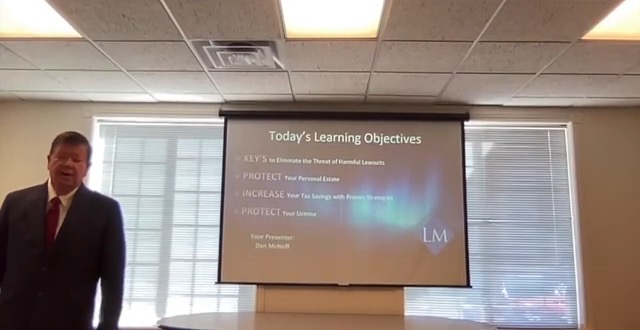
“Your Presenter — Dan McNeff” — the seminar’s own 00:09 intro slide, beside the Legally Mine logo, is the attribution: a source-context identification, not a biometric match. “Garrett Soelberg” is only the channel that uploaded the video, not the presenter. Quoted accurately; this is the product as sold, in the principal’s own words, not an admission of any crime.
A registry sweep across the other states the family touches confirms the pattern is not confined to Utah and Alaska. The same captive agents and the same Orem-and-Provo addresses recur from Oregon to Connecticut, and the McNeff roster runs deeper than the names above: official Utah filings tie further family members, among them Joshua and Nicole McNeff, to their own Orem shells on the identical agent-and-address pattern. The franchise layer mirrors the method too. The “BAMF [City]” store companies recur across Utah, Oregon, Florida, Montana and Connecticut, several managed by the McNeff sons or BAM’s own chief financial officer; and one independent Bricks & Minifigs operator holds matching “BAMF Holding” entities in two states at once. The loop even returns to where it began, in asset protection: the insider installed over the Salem store doubles as an executive of a Las Vegas asset-protection firm. The same sweep is disciplined the other way, where a “BAMF” name proved to belong to an unrelated operator, it is set aside; the point is the documented web, not the echo of a name. None of this is a fresh accusation. It is the one structure, traced across more dockets, exactly as a regulator following the agents and the addresses would find it.
And it is not only the lenders’ suits that ended without a verdict. Look at how nearly every dispute this family has touched is closed. The Ohio unauthorized-practice case was resolved by consent, on an express waiver of notice and a hearing, with no facts ever found. Ohio Bar v. Legally Mine Its own federal lawsuit was voluntarily dismissed. Mcneff V Mcneff Utd 2-21-cv-00048 doc12 Voluntary Dismissal 2021-02-10 The California customer’s case was steered out of court into private arbitration. Eliasieh v. Legally Mine, LLC, No. 18-cv-03622-JSC, 2020 WL 1929244 (N.D. Cal. Apr. 21, 2020)✓ And the answer to a critic was a gag order obtained without a hearing. BAM v. Schneider-Mansell, No. 260402353 Each of these is a lawful way to end a case; the repeated pattern matters. A business built to make assets hard to find is run by people who, matter after matter, also make the facts hard to test, closing each one by consent, dismissal, arbitration, or settlement before a neutral adjudicator can weigh the evidence. The asset-protection product and the litigation habit are one instinct aimed at two targets, and it is why the single thing that can force a tested record, an anti-SLAPP special motion, is the most dangerous motion in this file for Bricks & Minifigs.
And the control-grab at the center of this story was not the first of its kind. In a 2020 complaint, a business associate and DDL Investments co-member named David Gibb alleged that Ammon McNeff had gone to the Utah Division of Corporations in November 2019, falsely declared himself the sole owner and registered agent of an LLC he did not own, and then redirected its merchant-account funds to an account he controlled. Afraid OF Lawsuits, LLC - Summary of Online Changes (2019-11-12) The mechanism resembles what the Salem franchisees describe: a paper filing that manufactures control, then a quiet move of the money. That case was dismissed without prejudice within months, never tested on the merits, which is itself the pattern; but a sworn allegation of the same maneuver, against a McNeff insider, years before the toy-store fight, sits on the record.
What follows from all of this, whether any of it is a crime, a tort, or a winnable defense, is laid out claim by claim in the legal reckoning further down, every theory graded for how far the record carries it. First, where this can actually go.
- Jun 15, 2026Existing expanded ledger contains 1285 raw events across layers including Bloomberg dockets, official UCC, USPTO/TSDR, TTAB, state documents,…
- Jun 2, 2026Official Utah UCC searches captured Legally Mine and BAM Franchising UCC chains; Daniel J. McNeff direct UCC search remained blocked by login/order…
- May 29, 2026Centra registered assumed names LEGALLY MINE LLC and LEGALLY MINE TAX AND ACCOUNTING LLC; these are tracked as separate DBA nodes from the old…
- May 22, 2026Handover reports Legally Mine renamed to LM OLDCO; direct official LM OLDCO pull remains a gap in this sprint.
- Feb 2, 2026Castle docket lists notice of discontinuance.
- Jul 16, 2025BAM IP Holdings filed/active with Ammon and Matthew managers.